First draft - incomplete at present
Engine Start and Warm-Up
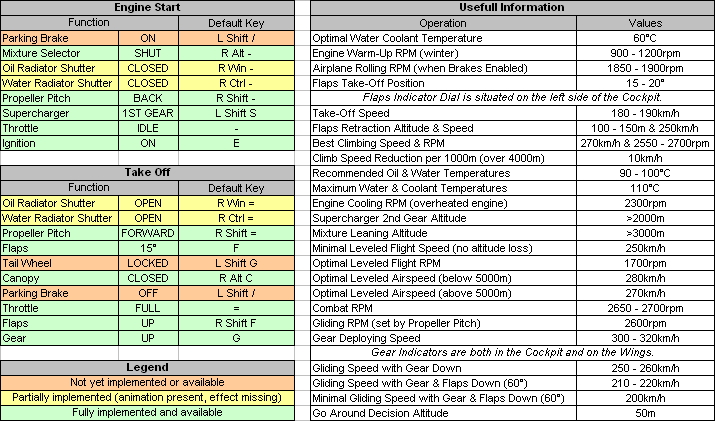
- Set the mixture selector to shut position (fully backward).
- Close water and oil radiator shutters.
- Set prop pitch control fully backwards (low pitch).
- Set throttle control to low.
- Start the engine and wait for stable engine operation with low RPM
- Engine warm-up RPM during winter time is between 900-1200RPM, normal coolant temperature is 60 degC without relation on oil temperature
- Check wheel brakes operation during taxi by pressing brake clutch and slowly advancing the throttle, keep airplane tail in down position. Airplane should start moving with 1850-1900RPM, after check, pull back throttle and depress brake clutch.
Taking Off
- Fully open water and oil shutter
- Set propeller control fully advanced (high position)
- You may use flaps down 15-20 deg position for shorten take-off roll.
- Make sure the runway is clear before rolling
- Softly advance throttle to its maximum position
- When rolling, keep your run straight and perform take-off with slightly lowered tail
- Push left rudder correspondingly to airplane tendency to yaw to the right. With rapid throttle increasing and tail up – airplane tendency to right yaw is higher
- When taking off with side winds the airplane will try to keep its nose into the wind
- To make your take-off roll straight check forward view by leaning to the left from gunsight
- Airplane gets airborne at around 180-190 km/h. Do not force airplane to go airborne at lower speeds as airplane controls are ineffective and it may lead to ground bumping by main wheels.
- After take-off at 250km/h you may lower your flaps at 100m height. Perform climb at 270km/h.
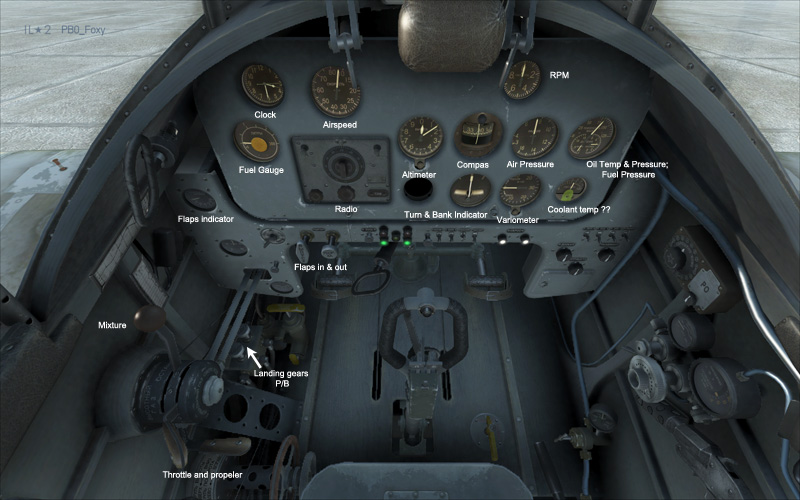
- Retract your gear and control it with cockpit light indicators and double check by mechanical indicators on wings.
Climbing
- Climb speed is 270km/h with 2550-2700RPM depending on water and oil temps.
- At altitudes higher than 4000m, lower climb speed by -10km/h for every 1000m of height
- Maximum water temperature is 110 degC. In case of engine ov erheat lower engine RPM to 2300 and perform climbing with higher speeds
- Recommended water and oil temperatures are between 90-100 degC
- Switch supercharger to 2nd gear after 2000m height
- When climbing you may use mixture selector to lean engine after 3000m
Level Flight
- Perform switch from climb to level flight by following steps:
- Set your speed with throttle position but no lower than 250km/h indicated at all altitudes
- After that adjust engine RPM correspondingly to airspeed with propeller pitch control; if airspeed drops due to lower pitch RPM setting, increase your throttle setting.
- In case when re-set from low speed flight to high speed flight;
- Close mixture selector;
- Set prop pitch control correspondingly to speed needed
- Only after that advance throttle control
- In case of combat and maximum speed flight steps to follow is;
- Close mixture selector
- Set RPM to 2650-2700RPM for all altitudes
- Set radiator shutters control by airflow position
- In case when flight is above 2000m set supercharger to 2nd gear.
- Routine flights, ferry flights, for best fuel consumption before entering combat areas and such, follow next recommendations: Set RPM to 1700, indicated airspeeds: for 5000m alt – 280km/h, above 5000m alt – 270km/h
Gliding and Landing
- Before gliding approach set RPM to 2600 with your pitch control, that makes touch and go easier in case of go-around after faulty landing attempt
- Gliding speed with gear down is 250-260km/h indicated, with flaps down to 60 deg – 210-220km/h, minimal gliding speed with flaps down to 60 deg – 200km/h
- You should always beware that during maneuvering the LaGG-3 bleeds its speed badly and gains it very slowly.
- On approach set gear down before 4th turn with speed 300-320km/h. Glidepath is much steeper with flaps down than with flaps up.
- Go-around decision alt is no lower than 50 meters.