As some may know, I spent two weeks in Lebanon in October.
It's a fascinating country and I dare say one of the most diverse ones on Earth for its size, which coupled with local sectarian mentalities is why it had a 15 year long civil war between 1975 and 1990, and tensions are still felt 26 years after it ended (Israeli occupation of south until 2000, Syrian occupation until 2005, devastating Israeli bombing and invasion in 2006, flareups and clashes between various groups until 2009, and a spike in bombings and clashes in between 2013 and 2015 - it's kind of calm now).
Here's a sect map of Lebanon to illustrate the blessing and curse which is its diversity. It's interesting that locals will boast about the country's unique religious diversity while it has caused so much strife and the locals themselves are often suspicious of members of different sects and seldom go to regions where another sect is a big majority.

Still, daily life goes by normally, and it's a pleasant place to visit providing you don't stay in Beirut for too long.
However I was fascinated by Beirut so I did stay there for a while and basically walked through 90% of this compact but very crowded, cluttered and claustrophobic city's neighborhoods and suburbs.
Here are some photos in two categories - the ugly and the beautiful, categorized according to the accepted international standard of my subjective opinion. And added info to perhaps make this crazy place less of an unknown for you.
The Ugly
Most of Beirut
Beirut is incredibly dense. Concrete is everywhere, (re)construction is everywhere, war ruins are everywhere. The one word to describe Beirut is contrast. Luxury five star hotels are flanked by abandoned war ruins, Ferraris and Lamborghinis drive by refugees sitting in the streets, run down neighborhoods and refugee "camps" without basic utilities are flanked by fancy new upscale glass residential buildings, decaying and smelly streets full of garbage lead into spotless new bars or restaurants that offer fine dining.
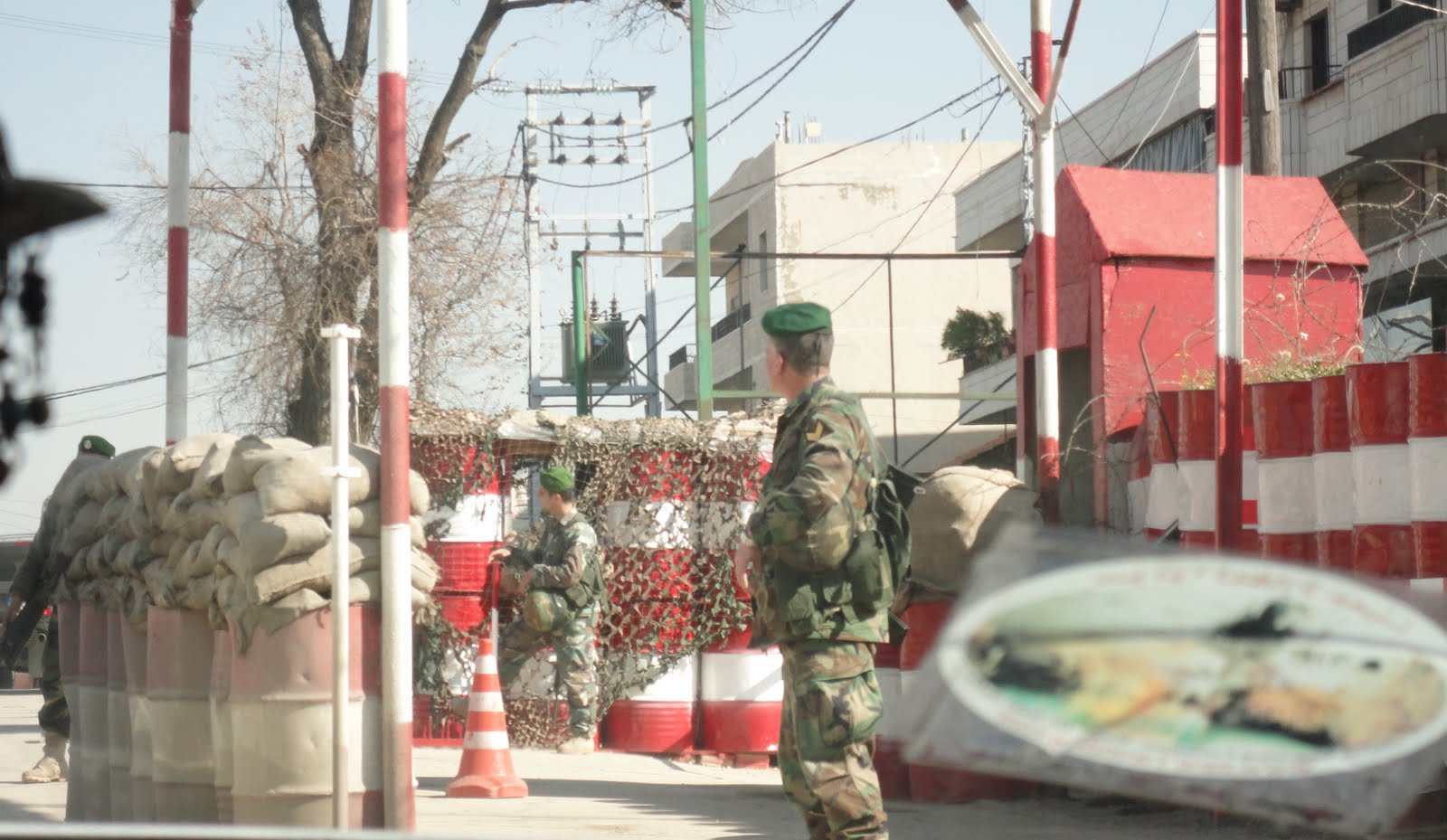
There is a huge military presence and walking randomly will probably lead you into a heavily fortified checkpoint in about five minutes - these include concrete barriers, portable pillboxes, barbed wire, armed soldiers and often one or several military vehicles, often armored. Taking photos around these guys is a bad idea, which is great since the most beautiful part of the city with the most historic ruins, mosques and churches is saturated with military presence, as it's also the part of town where important state and international institutions are located. I didn't take photos of these (not that I didn't try, but usually there's one soldier at least who's very alert all the time) but they look like this, this or this. They are prevalent all over the country, but especially in Beirut. Armed patrols are also common on major city roads, convoys of 3-5 Humvees with .50's mounted in the back, soldiers manning them. Hezbollah also maintains its own checkpoints in areas where it's dominant, like south Beirut or the south and northeast of Lebanon.
There is only one public park (excluding the American University of Beirut's campus which is also kind of a park) and it's far from the city center and was closed to the public until 2015 for "security reasons".
Construction and ruins and contrasts


This is in my own hostel


Your typical protected building, only this one didn't have armed guards, but you can see concrete barriers and tiny windows.

Garbage is a massive problem in all of Lebanon, it's normal to throw water bottles and lunch leftovers out of cars or public transport. Here I took a picture of Beirut's most known and photographed attraction, the Pigeon Rocks, from a slightly different perspective for more context.


Beirut's Holiday Inn hotel worked for less than a year after it opened in 1975. As the civil war broke out, militants fought fierce battles over this and other high rise hotels because they offered a vantage point over much of the city center. Now, over 40 years later, it still stands in ruin, towering over the posh center of Beirut, because of an ownership dispute.

Electricity is a problem in much of Lebanon, and even in Beirut, most of which has the luxury of 24 hour electricity, going outside the city center one will notice that street lighting simply doesn't exist in some places. Couple that with rubble or pieces of large garbage like remains of scaffolding lying on the pavement sometimes, or open manholes. Joy. Towns and villages outside of Beirut rely on generators to cover the outages - these are frequently provided by private companies that cover entire neighborhoods or villages and turn on automatically a few seconds after the outage starts.

This over/underpass and road are totally unlit


Surely

Beirut is urban chaos at its best

Dawra is an eastern suburb of Beirut and transport hub for anything going north or northeast of Beirut. It's an area heavily populated by south Asian and African immigrants. They're a caste of their own, and work almost exclusively as cleaners or gas station clerks. I was surprised to see that Lebanon has so many immigrants from far away, but apparently they can get jobs that the Lebanese themselves don't want to do, and there are entire armies of these immigrants working low tier jobs everywhere around the country. These people are (like Syrian refugees) royally ripped off by their Lebanese landlords. As my host Marwan told me, a 2 room apartment costing 400$ per month is rented by the room by the person for 100$ to immigrants/refugees, thus you would have two families living in one apartment, each in their own room, paying 100$ per person each, and being from Africa and Asia these are usually bigger families.