Terminator Vision: How does a Pulse Doppler Radar see the world?
Whoever has seen a Pulse Doppler radar, whether in real life or in pictures, could think they are pretty alien looking devices. A large electronic piece of equipment, with wires and tubing coming in and out, and a large, often flat antenna at the end, which usually has the ability to move. This all hidden in a nosecone that is completely translucent, but only to radio-waves. Surely there can be no comparison to something as mundane as the human body?
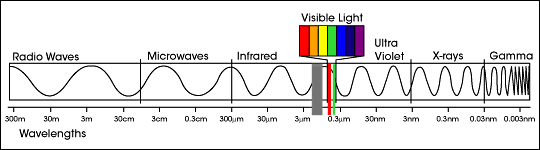
Technically, radio-waves are waves of a type we call electromagnetic radiation. Another type of electromagnetic radiation is.. Normal every day light. The very type coming of your screen right now. There are major differences of course. The cellphone right next to you can communicate with the closest cell tower with no problems, while your vision is limited to the very room you are in now. You cannot see very far in bad weather, but the radar at your local airport has every nearby airplane on their scope. In order to visualize the radar, I’m going to compress the wavelength, λ from metres into micrometers (µm) In order to allow you to see them! Technically, a specific hue of yellow sits in the middle of the visible spectrum, but in order for the best contrast I’m going to ‘calibrate’ my radar to green.
© NASA
This is what you see with your own eyes when flying over a specific part of the Georgia terrain near the mountains. beautiful, is it not?
This is the very same scenery as seen through a Pulse-Doppler radar. Important to note that all the colours are gone. I’ll explain more about that later. Also the beautiful atmosphere, which reflects a lot of blue colours, is not very good at reflecting radar waves. Any targets high in the air have nothing but cold, dead space as their background.
We see an F-15 that is travelling away from us! but somehow it has a different colour than the background. This is because by travelling away from us, the F-15 causes reflected radar-waves to have a lower frequency, their wavelength elongated. This causes it to appear to be of a different colour to the Pulse-Doppler radar. It is now very visible, and could possibly be locked on to. This effect is called Redshift8.
We now see an F-15 coming right at us! The effect is reversed. The frequency is increased, the wavelength gets compressed. It now appears blue to the Pulse-Doppler radar!
This concludes the first learning objective of this chapter. A Pulse-Doppler radar is sensitive to motion of objects closing in or receding.

© Universal Pictures
A vision based on movement. Quite useful when one has to fight fast-movers, don’t you think? However, what would happen if we didn’t close in or recede from the doppler radar all? Just perfectly sideways? We now don’t close in or recede from the radar any more than the surrounding terrain.
With only cold space as our background we are still very visible.
However with only terrain as background we become nearly invisible! An important thing to remember is that it may take longer for a pulse to return from the background terrain than it would from your jet. So under certain conditions ( either high altitude or at slant angles) The lock could possibly be maintained.
For the next learning objective. I have a task for you to do. I want you to look up some images of 4th generation fighters. The F-16, The F-15 (naturally) and also some newer or stealth designs. The F-117, the B-2, the F-22 and the F-35. I want you to take a good look at the air intakes especially. Even to the untrained eye, it is apparent that the designers went through a great deal of effort, even on the 4th gen, to hide the first stage compressor blades, “the fan”. On the stealth designs, the fans are not visible at all from the outside. The fifth generation US/NATO fighters appear to have some sort of system that can block the view on the fans, called a diverterless inlet25 which also has other benefits. In-case you didn’t see any of those, I’ll provide one image.
Image credit: ontheroger.proboards.com
With those images fresh in mind, let’s take a look at the complete opposite. An abomination in terms of RCS (radar cross section). The A-10C Thunderbolt II. Also known as the Warthog, a favorite aircraft for many readers of this article, I’m sure.

In this angle, the Warthog is approaching us and thus appears blue. However, there is something special about the fans. Fans typically move at a high subsonic speed. In this angle, half of the blades are moving away from us,they appear red to our radar. The other half is approaching us, and appear Violet (You can think of violet like blue, but worse). This effect is about as attention grabbing to the Pulse-Doppler radar as a poison dart frog is to your humanoid eyes. It is also an important component of the NCTR (Non-Cooperative Target Recognition) system. The computer ‘understands’ these are the intakes and with other parameters, calculates the distance between them and compares this with a table of known aircraft models. The last thing is that the fan, by its very nature is, constantly moving. This means that whenever a new pulse arrives at the target aircraft. The fan will be in a different position. Each and every pulse than has a chance to be reflected ‘perfectly’ of a fan blade. Increasing visibility. The chance is increased if the repetition frequency of the pulse is higher. What are you supposed to learn? The F-15 may give his position and presence away if flying directly at a hostile. That’s the only way you can get to see the fans on the F-15.
There is a weapon in your arsenal that allows you to defend yourself against radar.. It’s called Chaff. Chaff are strips of aluminium, tin or plastic coated with a metal that reflect radar waves. The purpose of this is to present ‘fake targets’ to the enemy.
Chaffs are very hard to see under normal conditions. So I will use a cloud to represent chaff. Like all other objects, Chaff appears coloured to the radar.
Chaff doesn’t fly very fast. It pretty much floats a few hundred milliseconds after it was dropped. Like all other non-moving objects, it appears green. This radar is not fooled by the enemy. Let’s hope the pilot had something nice to eat during his last meal because it was probably his last. Dropping chaff is near useless when approaching or receding from the enemy. You can only hope a bundle of chaff blocks the radar from looking directly at you if you are receding. So what happens if we combine the knowledge with what we learned before? If we fly directly sideways and then deploy chaff?
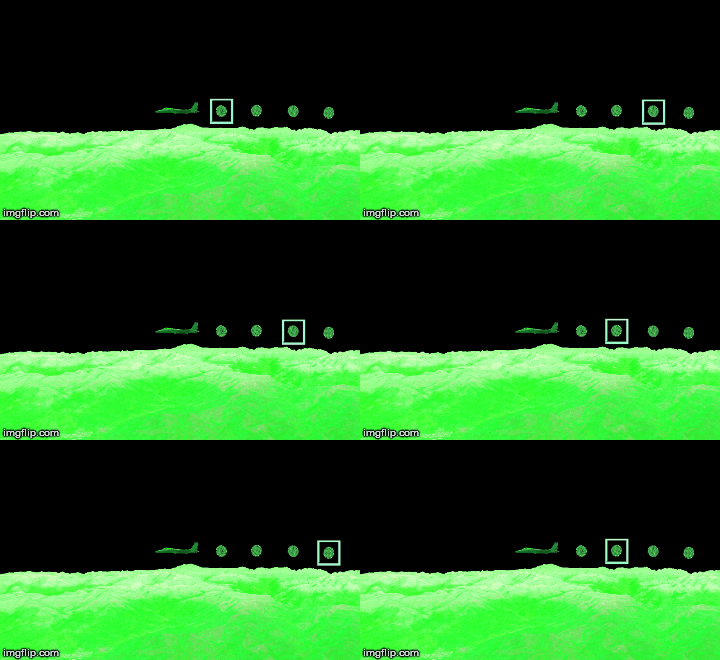
Jackpot! Add in background clutter and it will be even more effective!



 2




 1